
 By kazimladimeji
When most people think about folding bikes, the Brompton probably comes immediately to mind. It’s compact, beautifully engineered and has become almost synonymous with folding bikes in the UK.
But what if you don’t need the smallest or lightest possible folding bike?
The Hygge Vester takes a very different approach. Rather than prioritising portability above everything else, Hygge has created a chunky 27 kg folding electric bike with 20 x 4-inch fat tyres, front suspension, a 250W motor and seven-speed Shimano gearing.
There are two versions to consider: the standard Hygge Vester with its conventional frame and the Hygge Vester Step, which adds a step-through frame for easier mounting and dismounting. Both are also available in the rather smart-looking Heron White.

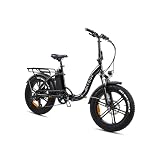
In this Hygge Vester electric bike review, I look at its features and specifications, who this bike is suited to, whether the Hygge Vester is road legal in the UK and whether it could be a good, considerably cheaper alternative to the Brompton Electric.
Hygge Vester Features and Specifications
| Specification | Hygge Vester / Vester Step |
|---|---|
| Frame | Folding aluminium |
| Frame options | Standard or step-through |
| Motor | Ananda 250W rear hub motor |
| Torque | 50 Nm |
| Maximum assisted speed | 15.5 mph / 25 km/h |
| Battery | Samsung 48V 14Ah removable battery |
| Claimed range | Up to 80 km / 50 miles |
| Gears | Shimano Altus 7-speed |
| Tyres | CST 20 x 4-inch puncture-resistant fat tyres |
| Suspension | Front mechanical suspension |
| Brakes | Tektro hydraulic disc brakes |
| Assistance | 5 pedal-assist levels |
| Lights | Integrated front and rear LED lights |
| Rear rack | MIK adjustable carrier |
| Weight | Approximately 27 kg |
| Folded dimensions | 98 x 52 x 76 cm |
| Rider height | Approximately 5 ft 4 in to 6 ft 5 in |
| Price | £1,499 at time of writing |
Hygge currently lists both versions at £1,499. The specifications include an Ananda 250W hub motor producing 50 Nm of torque, a removable Samsung 48V 14Ah battery, seven-speed Shimano Altus gearing, hydraulic disc brakes and a claimed range of up to 80 km.
What’s the difference between the Hygge Vester and Vester Step?
Not very much mechanically.
The biggest difference is the frame.
The standard Hygge Vester uses a more conventional folding bike frame, whereas the Vester Step has a much lower step-through design.
For riders who regularly stop and start in town, have reduced flexibility or simply don’t fancy swinging a leg over a chunky 27 kg fat-tyre bike every time they get on, I’d seriously consider the Vester Step.
Apart from that, the basic proposition is much the same: fat tyres, front suspension, seven gears, hydraulic brakes, a 250W motor and a large removable Samsung battery.
Who and what is the Hygge Vester suited for?
For me, the most interesting thing about the Hygge Vester is that it doesn’t feel like a folding bike designed exclusively around commuting.
Yes, it folds, and that makes it easier to store in a flat, garage, office or car. But at 27 kg and with a folded footprint of 98 x 52 x 76 cm, this isn’t something I’d particularly want to carry around a railway station every morning.
This is more of a fold-it-for-storage folding bike than a carry-it-everywhere folding bike.
Where it gets interesting is out on the road.
British potholes and rough roads
Those massive 20 x 4-inch tyres should provide considerably more cushioning than the narrow tyres you normally associate with traditional folding bikes.
Throw in the front suspension and suddenly potholes, broken tarmac, rough urban roads and cobbled streets become much less intimidating.
If your daily commute involves badly maintained roads—and let’s face it, that’s hardly unusual in Britain—there’s a lot to like here.
Winter riding
This is another area where the Vester makes sense.
Fat tyres provide a large contact patch and the CST multi-terrain tyres should offer plenty of grip on wet, dirty and uneven roads.
I’d much rather tackle a wet, potholed winter lane on these 4-inch tyres than on the skinny tyres traditionally fitted to compact folding bikes.
That doesn’t make it an ice bike, of course, and fat tyres won’t magically provide grip on sheet ice. But for the normal mixture of puddles, broken surfaces, mud, wet leaves and general British winter-road nastiness, the Vester looks very well equipped.
Canal paths and weekend adventures
This is where the Hygge Vester moves away from being simply an urban folding e-Bike.
The fat tyres and front suspension give you the option of heading down canal towpaths, gravel tracks, park trails and other light off-road routes at the weekend.
I wouldn’t mistake it for an electric mountain bike, but you don’t need a mountain bike for most towpaths and light trails.
It should also be excellent for exploring older cities with cobbled streets, rough lanes and those wonderful little snickleways you occasionally discover where a conventional narrow-tyred folding bike can become a little uncomfortable.
You could commute on it Monday to Friday, fold it into the car on Saturday morning and then spend the afternoon exploring a canal path or forest trail.
That’s a level of versatility I really like.
Is the Hygge Vester good for hills?
It should be pretty capable.
You’ve got 50 Nm of torque from the 250W Ananda motor combined with seven Shimano gears.
The gears are important.
An electric motor doesn’t eliminate the need for sensible gearing, particularly when you’re tackling steep hills. Having seven gears gives you considerably more flexibility to find a comfortable cadence while the motor provides assistance.
There is a downside to those massive tyres. Fat tyres create more rolling resistance and the Vester itself weighs 27 kg, so this isn’t going to climb like a lightweight electric road bike.
But that’s not what it’s designed for.
For normal urban hills, rolling countryside and short steeper gradients, the combination of 50 Nm motor torque and seven-speed gearing looks more than adequate.
Is the Hygge Vester a road-legal e-Bike in the UK?
Yes, the UK version is marketed by Hygge as a road legal electric bike, and its published specifications fit the key Electrically Assisted Pedal Cycle (EAPC) parameters.
The Hygge Vester has a 250W motor and electrical assistance is limited to 15.5 mph (25 km/h). Hygge also states that the Vester is UK road legal and UKCA/CE certified.
Under current UK rules, an EAPC must have pedals capable of propelling the bicycle, its motor must have a maximum continuous rated output no greater than 250W and electrical assistance must cut out at 15.5 mph. A compliant EAPC can be ridden without registration, road tax, insurance or a driving licence, although the rider must be at least 14.
That means you can use a compliant Vester anywhere an ordinary bicycle is legally permitted, including roads and cycle paths. You can’t simply ride it on ordinary pavements.
One important caveat: don’t modify the motor or speed limiter. A modified e-Bike capable of providing motor assistance above the EAPC limits can become a motor vehicle in the eyes of the law, bringing licensing, registration, insurance and other requirements into play.
Is the Hygge Vester a good alternative to the Brompton Electric folding bike?
This is where things get interesting.
The Brompton Electric C Line is arguably the benchmark electric folding bike in Britain, but I don’t think these bikes are actually trying to do quite the same job.
The current four-speed Brompton Electric C Line costs £2,999, compared with £1,499 for the Hygge Vester. So the Vester is almost exactly half the price at current manufacturer prices.
But there are some major differences.
| Hygge Vester | Brompton Electric C Line | |
|---|---|---|
| Price | £1,499 | From £2,999 |
| Gears | 7 | 4 |
| Weight | Approx. 27 kg | From 17.3 kg |
| Wheels/Tyres | 20 x 4-inch fat tyres | Compact 35C tyres |
| Suspension | Front suspension | No conventional front suspension |
| Claimed range | Up to 80 km | Up to 90 km |
| Folding priority | Storage/transport | Maximum portability |
| Best suited to | Rough roads, mixed surfaces, leisure + commuting | Commuting, trains, offices and maximum portability |
Brompton lists its current Electric C Line at 17.3 kg with a tiny folded footprint of approximately 58.5 x 56.5 x 27 cm. That’s a huge advantage if you’re regularly carrying your bike onto trains, into offices or up flights of stairs.
The Vester weighs around 10 kg more and folds into a considerably larger package.
If portability is your number-one priority, I’d buy the Brompton.
But turn the comparison around and the Vester starts scoring points.
You’ve got seven gears rather than four, 4-inch fat tyres, front suspension, hydraulic disc brakes and a considerably lower purchase price.
For someone living in a hilly area, (like me in the Cotswolds) the seven-speed gearing is attractive. And if your commute includes potholes, cobbles, broken tarmac or rough cycle paths, I’d expect those huge tyres and suspension to make the Vester a considerably more forgiving machine.
Then there’s weekend riding.
The Brompton is fundamentally an exceptionally clever urban folding bicycle. The Vester feels more like a compact fat-tyre adventure e-Bike that happens to fold.
That’s an important distinction.
If I were commuting by train every day and needed to carry the bike through stations, I’d want the Brompton.
If I wanted a folding bike for commuting during the week but also wanted to explore canal paths, light trails, cobbles and rough country lanes at the weekend, I’d be seriously tempted by the Vester.
And saving around £1,500 certainly doesn’t hurt.
Is the Hygge Vester worth buying?
I think there’s a very clear market for this bike.
Don’t buy it simply because you want the smallest possible folding electric bike. It isn’t. At 27 kg, you probably aren’t going to enjoy carrying it around.
Instead, buy the Hygge Vester because you want the versatility of a fat-tyre e-Bike combined with the storage convenience of a folding frame.
The 20 x 4-inch tyres, front suspension, hydraulic brakes and seven-speed drivetrain make it far more interesting to me than a conventional urban folder if your riding regularly ventures beyond perfectly surfaced roads.
At £1,499, it also sits at an attractive price point compared with premium folding electric bikes.
Personally, I’d probably choose the Vester Step. On a relatively heavy 27 kg e-Bike designed for stop-start commuting and leisure riding, the easier mounting and dismounting of the step-through frame makes a lot of sense.
And in Heron White, it looks pretty smart too.